Rethinking Third Places Around Light Rail Stations
Course:
HCDE 518
Timeline:
Autumn 2024


Introduction
Coined by sociologist Ray Oldenburg in 1991, the term third place refers to an informal public gathering space outside of home and work that fosters belonging and community connection¹. There has been a recent decline in third places due to “economic, social, behavioral, technological, and policy changes”, negatively impacting mental health, community belonging, and social equity²𝄒³.
Throughout this 9-week course project, we explored revitalizing third places in different communities. We found that Seattle’s rapid urban development, particularly around its growing light rail system, offered a unique opportunity to integrate new third places near transit hubs. Moving forward, we focused our project around the question: How can we improve third places around Link light rail stations in Seattle?
Photo credit: Gail Wong, Urban Sketches Seattle
Research
Through our research, we wanted to understand individual motivations behind Link light rail usage and attitudes towards existing nearby third places in the Greater Seattle area. We conducted secondary research, rapid ethnographies, and a web-based survey. The questions we explored were:
What types of spaces do Link riders visit when traveling via the light rail?
What kinds of spaces do Link riders want near light rail stations?
What improvements could make spaces near light rail stations more inclusive for all Link riders?
Secondary Research
We reviewed over 15 sources of existing literature and research surrounding third places and adjacent topics such as community psychology, urban planning, global perspectives, inclusivity, and anti-racism.

Map of different topics reviewed and their interconnectedness
Rapid Ethnography
We conducted rapid ethnographies at several Link Light Rail stations, including Columbia City Station and U District Station. By immersing ourselves in the environment, we could better observe rider behaviors, available amenities, and station accessibility.

Left: Columbia City Station, Right: U-District Station
Survey
We recruited survey respondents by putting up fliers near several Link light rail stations in the Greater Seattle Area. The survey was also shared online on various social media platforms and through student networks.

Left: Survey fliers put up at light rail stations, Right: Outline of web-based survey
Research Insights
According to our secondary research, third places:
Foster social interaction, community belonging, quality of life, inclusivity, and overall well-being
Are critical to public health, providing environments that enhance resilience against stress and loneliness⁴
Through rapid ethnography, we discovered stations lacked:
Amenities (restrooms, trashcans, Wi-Fi)
Seating for waiting, adequate coverage from the weather
Our survey insights found:
50%
of survey respondents were from Columbia City Station
84%
reported wanting more community spaces near light rail stations (parks, playgrounds, community centers, and co-working spaces)
Respondents disliked the lack of seating, bathrooms, and available community spaces

Our research insights by category
These insights guided our design requirements and ideation, narrowing our scope to designing a third place for Columbia City Station with an emphasis on community engagement and public amenities.
Ideation
To kick off ideation, we identified the following as out of scope:
Detailed construction plans and city codes
City-wide development or large-scale infrastructure changes
Funding and policy implementation
Phase 1: Generating Ideas
In the first phase of ideation, we brainstormed various concepts and ideas that incorporate the needs of Link riders into a community space. We sketched a wide range of possibilities, prioritizing inclusivity and utility.

Our early sketches (including seating, garden features, art installations, potential parks and cafes, and an app for riders)
Phase 2: Applying Ideas
For the second phase of ideation, we honed in on practical ways of applying our ideas to an empty plot of land adjacent to the Columbia City Station.
Our final sketches focused on two key concepts: a passenger cafe and a community garden, each addressing unique aspects of community engagement and Link rider needs.

Left: Empty plot of land highlighted in pink, Right: Our final sketches selected for prototype development
Through feedback and reflection, we found these concepts to complement each other and combined them into a unified solution for our prototype: the Community Garden Café, designed to provide a welcoming, inclusive space with accessible amenities for both Link riders and the surrounding community.
Design Goals
Before beginning the prototyping process, we defined our design goals based on insights from our user research and constraints of the physical space.
Our design goals were organized into three main categories:
Accessibility and Convenience: Entrances, walking paths, and seating areas must be easily accessible and ADA compliant. Design should include flexible seating options, both indoor and outdoor.
Safety and Comfort: Environment must be clean, well-lit, and actively monitored to ensure safety and willingness to spend time in the area.
Space Design and Flow: Area must include designated spaces that support Link rider needs, including amenities for eating, drinking, bathrooms, and community activities. Design should optimize flow of people and reduce congestion.
User Flows
We mapped out several user flows to better understand how visitors would interact with the Community Garden Café. Guided by our user research and final sketches, these flows informed decisions about the physical layout and amenities, ensuring design goals were met while minimizing friction points.

User Flow used for our storyboard prototype
Prototype
Due to time constraints and limitations of prototyping for a physical space, our team created an interactive storyboard that would visually represent the interaction and experience of visiting the Community Garden Café.
In addition to the physical space, we expanded our prototype to include screens for an accompanying "Explore My Station" website. This was influenced by our goal of providing users with easily accessible information around station amenitites and nearby community spaces.

Medium fidelity prototypes used for usability testing; Left: Website screens, Right: Several of the storyboard screens created
Usability Testing
We conducted usability testing with three Link riders. We sought feedback on the functionality and experience of visiting the Community Garden Cafe and the navigation of the accompanying website.
During testing, participants navigated the storyboard scenario and made choices based on how they would engage with the physical space in real life. They talked us through their exploration of the website and shared their thought process.
Main Takeaways:
-
Preference for water fountain (to cover nearby road noise), greenery, cleanliness, and covered outdoor seating
-
Preference for website over app (due to ease of use) and desire for website to be backed by city or transit authorities for reliability
Final Design: Community Garden Cafe

Left: Proposed site plan for empty plot of land near Columbia City Station, Right: 3D rendering of proposed site plan

Left: Proposed floor plans for cafe interior (top and bottom level), Right: 3D Rendering of proposed floor plans
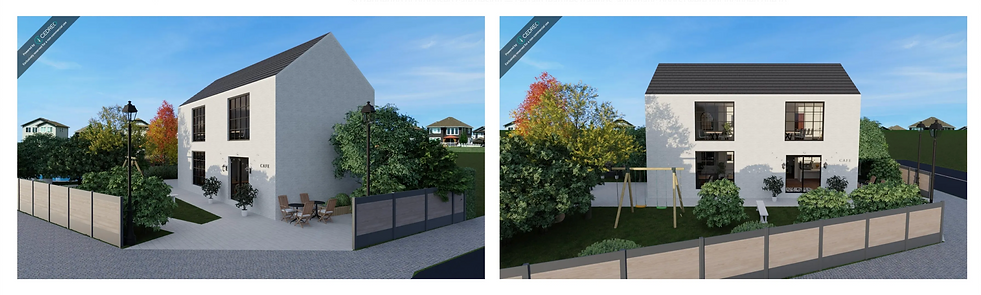
3D rendering of proposed cafe design — certain features (railings, automatic doors) were not included due to software limitations
Final Design: Explore Link Light Rail Stations


Proposed design for “Explore Link Light Rail Stations” website backed by Sound Transit
Conclusion
The Community Garden Cafe represents more than just a physical space — it’s a vision for fostering inclusivity, accessibility, and connection within urban environments.
Our design combines physical and digital approaches to transform Columbia City into a thriving community hub where Link riders and local residents can relax, connect, and engage with their surroundings. We hope this solution inspires similar initiatives to create sustainable third places for all.
References
-
Project for Public Spaces. (2008, Dec 31). Ray Oldenburg. Project for Public Spaces. https://www.pps.org/article/roldenburg
-
Steuteville, R. (2024, July 3). Vanishing third places and what can be done. Congress for the New Urbanism. https://www.cnu.org/publicsquare/2024/07/03/vanishing-third-places-and-what-can-be-done
-
Wolfe, C. (2023, June 21). From vacant storefronts to vibrant hubs: Revisiting ‘third places’ for urban resilience. GeekWire. https://www.geekwire.com/2023/from-vacant-storefronts-to-vibrant-hubs-revisiting-third-places-for-urban-resilience/
-
Finlay, J., Esposito, M., Kim, MH., Gomez-Lopez, I., Clarke, P. (2019, Nov). Closure of ‘Third Places’? Exploring Potential Consequences for Collective Health and Wellbeing. National Library of Medicine. https://pmc.ncbi.nlm.nih.gov/articles/PMC6934089/